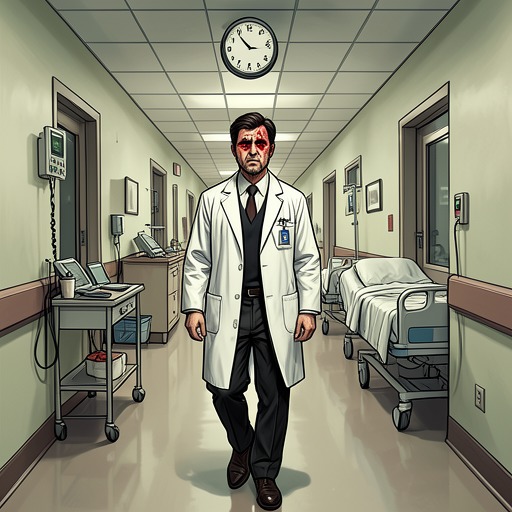
Severe sleep deprivation and fatigue among NHS doctors
This Is Going to HurtSevere sleep deprivation and fatigue among NHS doctors is not presented as an occasional inconvenience but as a working condition with consequences for care, safety, and life beyond the hospital. Adam Kay’s account moves from punishing weekly hours to near-misses on the road and an error during an exhausting shift, showing how fatigue can become both an individual danger and a system-level risk. Its force lies in the gap between the responsibility doctors carry and the limited opportunity they are given to recover.
Excessive Hours and Unrelenting Demand
The pressure is visible early in Kay’s career. In one week he works ninety-seven hours, none of the extra hours eligible for pay, and realizes that he has seen H for less than two hours. The contrast makes the cost of the rota concrete: time is consumed not only by work itself, but also taken from a relationship outside it. The passage gives no account of a compensating period of rest; instead, the accumulated hours appear as a measure of how little control he has over his time.
During a night shift, the workload becomes an arithmetic impossibility. Each patient needs at least fifteen minutes, but a new one arrives every five. With senior doctors occupied in a busy A&E, Kay must assess who sounds most urgent, attend to those patients first, and explain delays to nurses calling about others. He tells some patients that reaching them may take six hours. Some understand; others see a doctor apparently choosing not to help. The mismatch between demand and available attention leaves him running between patients throughout the night. The shift ends with everyone alive, but survival is not evidence that the workload was manageable.
At eight in the morning, a nurse calls to praise his work and say she thinks he is a good doctor. Kay has received little praise since starting the job, and he is so tired and startled by the kindness that he ends the call by telling her he loves her. The accidental intimacy captures how depleted he is, but also how rare acknowledgment has become: a brief expression of approval matters because it arrives amid an otherwise relentless shift.
Fatigue as Impaired Attention
By June 2008, the danger extends beyond the ward. After a difficult night shift and no sleep, Kay drives through a red light without noticing. He has spent thirteen hours working on a labour ward, but the police do not treat that explanation as a reason to waive the penalty: he receives a sixty-pound fine and three points on his licence. The incident places clinical exhaustion in an ordinary public setting. The same depleted attention that threatens performance at work travels with the doctor on the journey home, where other road users may also be at risk.
Two years later, his fatigue is described as a persistent disruption of awareness. He wakes to find an older man tapping on his car window with an umbrella: Kay has fallen asleep while waiting at a red light. Earlier, he had nearly fallen asleep sitting on a stool while waiting for a patient. These are not restorative naps taken by choice, but involuntary lapses occurring as he tries to remain awake through his duties and travel home.
The conditions make recovery difficult. Staff are told not to use empty hospital rooms to sleep during night shifts, and are expected to stay awake throughout the shift. Daytime sleep is difficult, Kay observes, and the repeated switch between sleeping at night and working in the day, then reversing the pattern, makes rest harder still. He argues that a brief nap during quiet periods could help doctors work better, particularly if they may be responsible for an emergency operation at seven in the morning. The point is not that every shift offers a safe opportunity to sleep, but that a blanket expectation of wakefulness ignores fatigue as a threat to performance.
Kay compares the resulting state to having had three pints: he feels not fully present and worries that he cannot react quickly enough. Yet arriving at work drunk would likely get a doctor sent home, while comparable impairment from lack of sleep is treated as part of the job. After leaving at 9:30 in the morning, he takes an hour to write his notes because he cannot find the words. He fears that one day he may fall asleep at the wheel and hit someone. The progression—from uncertain reactions, to difficulty writing, to a specific fear of a crash—shows how the risk accumulates across clinical work and the journey home.
Clinical Consequences and Patient Safety
A short-staffed night shift in November 2010 makes that risk more than hypothetical. Kay runs from one crisis to another and loses count of the babies he delivers. For twelve hours he has neither sat down nor closed his eyes; his dinner remains in his locker, and he mistakenly calls a midwife Mum. At the end of the shift, he performs an emergency caesarean. The baby needs urgent care but soon appears well. Afterward, another doctor tells him that he has accidentally cut the baby’s cheek during the operation.
Kay returns to the family, apologizes, and explains what happened. The parents, focused on their newborn daughter and the urgency of her delivery, say they understand. The cut is not expected to leave a scar, but Kay keeps thinking about how it might have been worse. He says he has never made this kind of mistake before and doubts it would have happened at the start of the shift, when he was less tired. That distinction matters: the account does not present the incident as an inevitable feature of surgery, but records Kay’s own concern that prolonged exhaustion compromised his performance.
He gives the parents information about how to make a complaint, though they do not want it. He then completes the notes and an incident form, anticipating that he will be called in and reprimanded. What he fears will be missed is the broader cause: long hours are dangerous for staff and patients alike. The episode places several layers of consequence side by side—the patient’s experience, the doctor’s responsibility, the formal reporting process, and the working conditions that may have contributed. The parents’ understanding relieves Kay, but it does not resolve the safety concern.
The book also records a hospital response to other preventable surgical errors. After a patient’s healthy kidney is removed and surgeons are reported to have drilled into the wrong side of patients’ skulls fifteen times in three years, staff attend a patient-safety talk. A new rule requires a large black arrow on the correct leg before surgery; after Kay raises the problem of a patient with an arrow tattoo on the wrong leg, management instructs staff to cover the tattoo and draw a new arrow. The contrast is telling: the hospital can define a visible marking procedure and amend it in response to a practical question. In the account of fatigue, by contrast, the prohibition on sleeping and the exhausting rota remain central conditions of work.
Exhaustion, Trauma, and the Limits of Coping
The narrative’s account of a later catastrophic birth concerns a different kind of crisis, and does not state that fatigue caused it. It does, however, show the emotional burden carried by the doctor who is expected to keep working through serious harm. The baby dies, the mother requires intensive care, and Kay, then the most senior person on the ward, cries while trying to write up his notes. He later says that he had not broken rules and that other doctors might have done the same, yet he continues to wonder whether he could have prevented the outcome. This distinction prevents the account from reducing every tragedy to tiredness: it also examines responsibility, uncertainty, and the strain of being the person others turn to.
After that crisis, Kay returns to work the next day and changes his clinical approach, deciding that even a small drop in a baby’s heart rate should lead him to perform a caesarean. He recognizes that this may mean operating on women who do not need surgery, but judges the possibility of avoiding another catastrophe worth the risk. He later describes the response not as recovery but as simply carrying on: for six months he does not laugh, and his smiles are not genuine. The hospital does not ensure that he can talk to someone, and he identifies a culture of silence that keeps support from those who need it.
This aftermath should not be mistaken for a medical diagnosis or attributed solely to sleep deprivation. Rather, it deepens the book’s picture of a profession in which depleted staff are expected to absorb both physical exhaustion and emotional shock without adequate space to recover. Kay asks to work part-time and is refused unless he is pregnant. He considers retraining as a general practitioner but is uncertain that he wants that work. A few months later, he leaves medicine. He says he did not tell people why at the time and found it difficult to discuss what had happened.
What Fatigue Costs—and What Remains
Leaving clinical work ends one form of exposure but does not erase Kay’s attachment to medicine. As a writer, he describes a bad working day as a crashed laptop or a poor review—problems he regards as minor beside the medical version of a bad day. He does not miss those worst days, but does miss colleagues, helping people, and the feeling on the drive home that he has made a difference. The comparison returns to the road, once the setting of danger after a sleepless shift, now remembered also as a place where work’s meaning could be felt.
The account therefore refuses a simple opposition between a dedicated doctor and a demanding job. Kay’s commitment to patients persists, but the conditions under which he works repeatedly expose patients and staff to avoidable risk. His experiences include a week of ninety-seven hours, a shift where five-minute arrival intervals defeat fifteen-minute care needs, involuntary sleep at a traffic light, impaired note-writing, and a surgical error he associates with being exhausted. Together, these details show fatigue not as a private failing but as a condition shaped by scheduling, staffing, rules about rest, and the expectation that doctors will continue regardless. The lasting significance is the conflict between care as a professional obligation and the human limits that the system asks caregivers to ignore.